

From oncoming headlights to faded lane markings, many visibility issues can make driving at night a struggle. The market is full of glasses claiming to solve the problem. But do any deliver? The answer depends entirely on the lens. Most night driving glasses are built on outdated assumptions about how glare works and what the visual system needs in low-light conditions.
This guide breaks down the science of night vision, explaining why most popular lens options fall short — and what an effective night-driving lens needs to do.
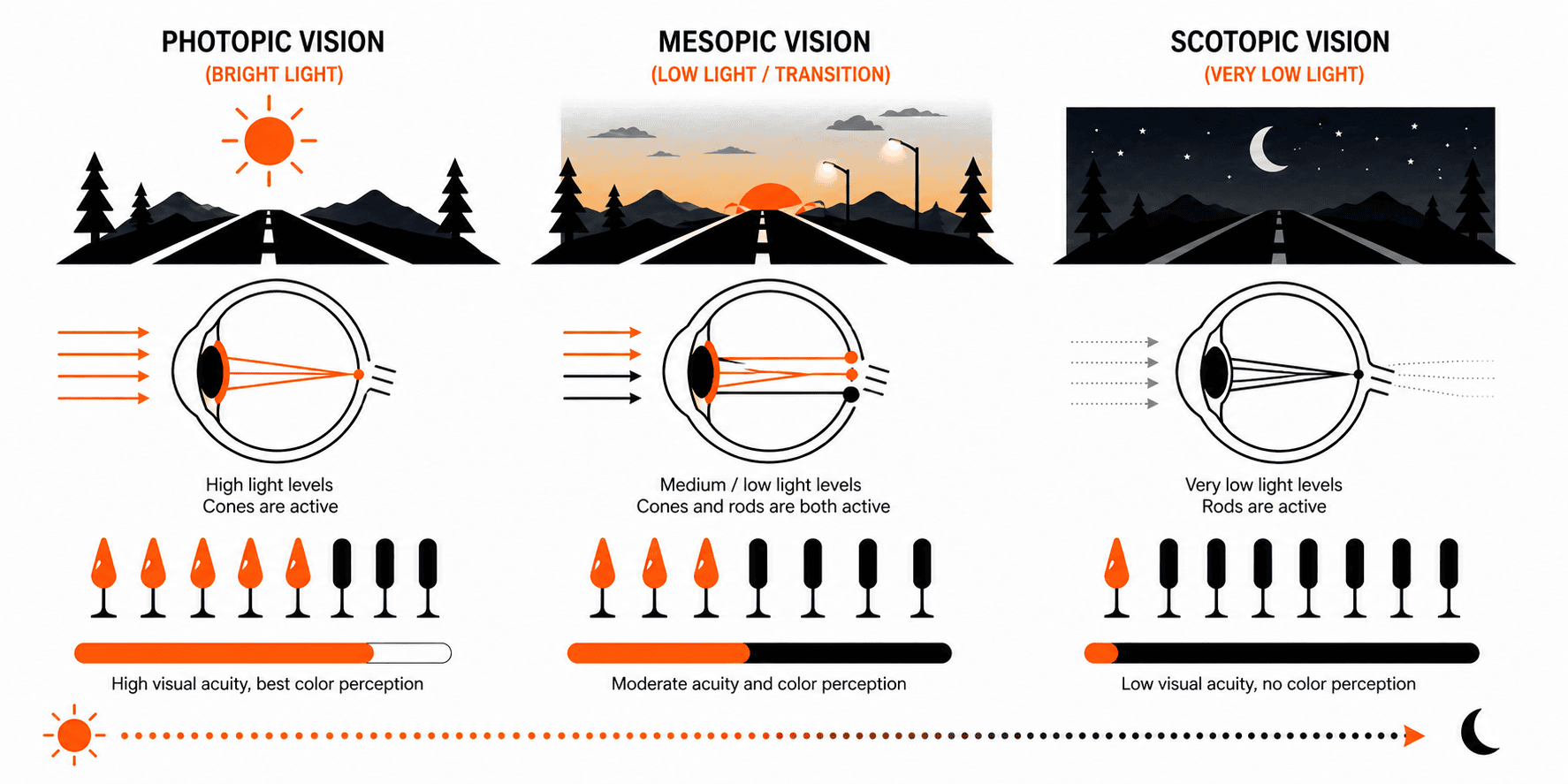
Your eyes operate differently in daylight and darkness. In bright conditions, your eyes’ cone cells handle vision — a process known as photopic vision. These cells are responsible for color differentiation, fine detail, and maintaining overall clarity while you drive.
As light fades to darkness, your eyes shift to scotopic vision, which relies on rod cells. These are more sensitive to low light, but come with trade-offs like reduced contrast sensitivity and poor color perception.
Between photopic and scotopic vision, there’s a transitional zone called mesopic vision, which is where most night driving occurs. The transition process matters because it leaves the visual system vulnerable to disruption. Broad, high-intensity light sources like modern LED headlights can overwhelm the retina and scatter light within the eye. This decreases visual performance through a phenomenon called glare dazzle or disability glare.
When glare hits your eye, it reduces contrast and forces the visual system into a recovery phase. That can take longer to process than you might realize. For example, at highway speeds, even one or two seconds of degraded vision can mean traveling the length of a football field with compromised sight.

Modern LED and HID headlights produce high peak intensities, with spikes in the blue-violet region of the spectrum. When this light enters the eye, it reduces contrast, making darker objects, such as pedestrians and lane markings, harder to see.
That’s why the first baseline requirement for any night-driving lens is an anti-reflective (AR) coating. AR coatings reduce surface reflections and increase total light transmission, which lets more useful light reach the eye while minimizing internal reflections.
However, AR coatings alone are not enough for safe nighttime driving. To understand why, let’s first take a look at the most popular, yet ineffective, alternative — tinted lenses.
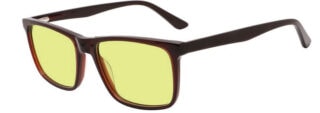
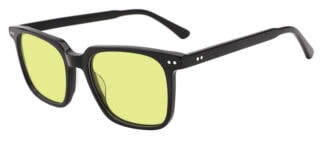
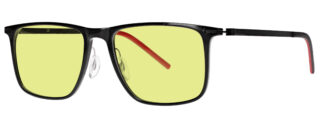
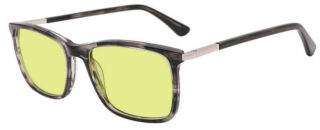
Most night-driving glasses rely on yellow or amber tints. These increase perceived contrast and reduce some blue light, which makes sight seem sharper and more comfortable. However, any tint on your glasses reduces the percentage of light that reaches your eye, or visible light transmission (VLT). That’s the last thing you want when driving in low-light conditions.
At night, your visual system is already operating near its sensitivity limits. Cutting VLT on top of that:
That’s why controlled studies on yellow-tinted lenses have failed to show any meaningful improvements in night-driving performance. In some cases, reaction times even get worse because the visual system receives less light to work with.
Since heavy tints aren’t good for night driving, you might go back to considering a clear lens with an anti-reflective coating. This is a better starting point for night driving, but it still comes with a critical limitation.
Standard clear lenses with conventional AR coatings treat all wavelengths of light equally. They reduce reflections across the full visible spectrum, failing to differentiate between the broad, low-intensity light you need to see and the narrow, high-intensity spikes of LED headlights.
Even while wearing clear AR-coated lenses, many drivers still experience intense glare, contrast issues, and slow visual recovery after headlight spikes. RX-Safety has designed a new form of night-driving glasses to address these concerns.
Halo Night Driving Glasses use the concept of selective filtration to improve visibility when driving at night. Instead of using a heavy tint to darken all light, they feature a specialized, multi-layer AR coating to target specific wavelengths. This helps the glasses dim the types of light that are most responsible for glare, such as high-frequency blue-violet light peaks from modern headlights. The approach does two critical things that support safer driving:

Filters out the bad light
By selectively filtering out the narrow spectral bands that contribute most to scatter and dazzle, these lenses reduce the intensity of disruptive headlight glare.
Preserves the good light
The rest of the visible spectrum passes through Halo Night Driving Glasses at high efficiency. This gives you a high overall VLT, helping you see road markings, signs, and pedestrians clearly.
Halo glasses offer a fundamentally different approach than clear, yellow, and amber lenses. They deliver the best of all options for night driving glasses while minimizing downsides like reduced VLT and poor contras
A night-driving lens should reduce scatter, preserve contrast, and shorten visual recovery time after bright headlight spikes. Selective-filter lenses do this more effectively than all other alternatives. They improve real-world driving by delivering:
Yes, some glasses help with night driving, but they aren’t the kind most people think.
Yellow-tinted lenses reduce visible light transmission and make it harder to see at night, which is counterproductive. Clear lenses with basic AR coatings are more helpful, but still treat all wavelengths equally. That means they can still lead to problems with glare and contrast.
The most effective glasses for night driving have a selective-filter lens. These target glare-causing wavelengths without dimming the rest of the visual spectrum. That’s the exact philosophy behind RX-Safety’s Halo Night Driving Glasses. They’ve become the gold standard for night driving by protecting the overall amount of light your eyes receive while also filtering out harmful spikes from intense headlights. It’s just what you need to drive more safely in low-light conditions.
Learn how Halo Night Driving Glasses can protect your vision at night here.
Stay on top of the latest news about prescription safety glasses, eyewear, sunglasses, and all the trends in the industry.
DISCOVER NOWBe the first one to know about promotion, new products, and more.
Follow Us On Instagram @rx_safety