










































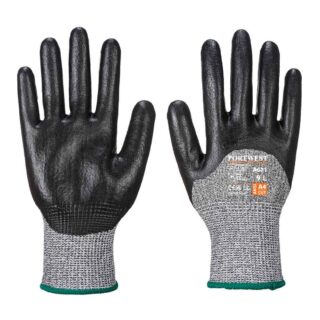
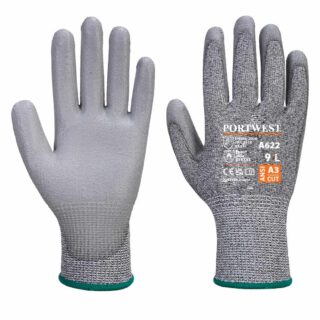
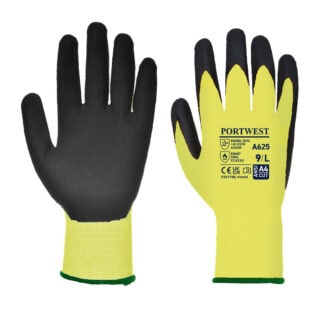

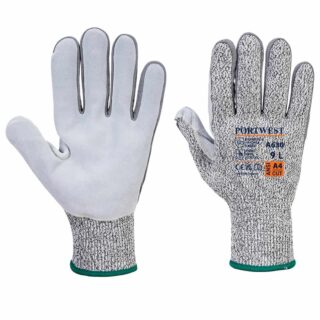
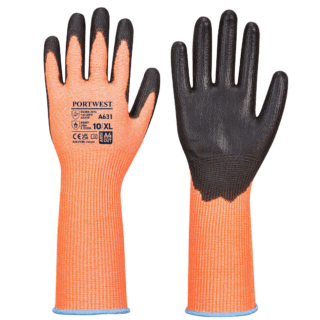
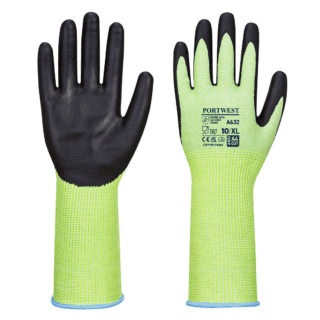
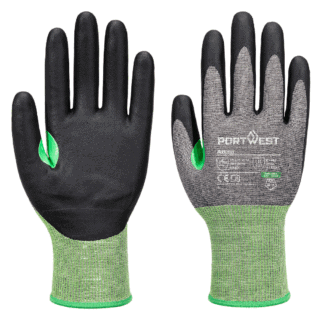
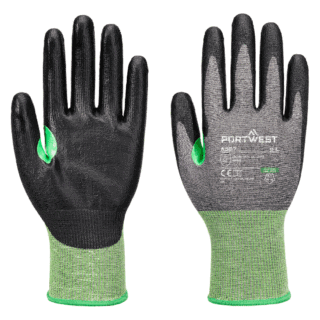
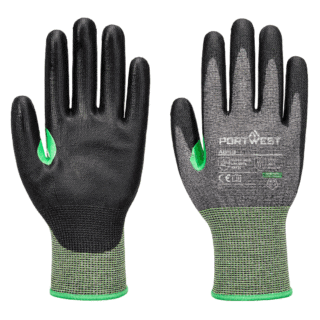
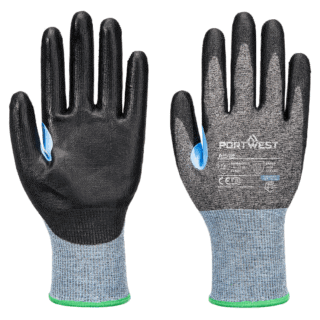

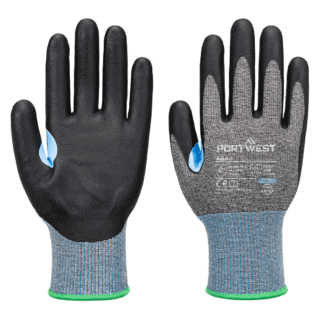

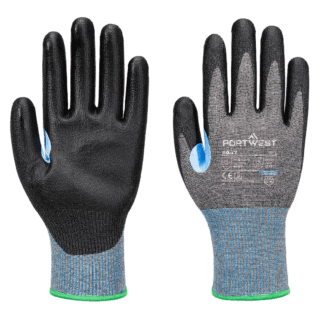

The US uses ANSI standards to rate cut-resistant gloves on a scale from A1 to A9. Higher numbers indicate a higher cut resistance. European countries use a different, but similar, standard called EN 388.
The test used to determine ANSI cut resistance uses a tomodynometer, referred to as TD-100. In a TD-100 test, a piece of cut-resistant fabric is held in place on an electrically conductive surface while a blade under a specified amount of pressure is moved across the surface.
If the blade makes contact with the conductive plate, it’s rated as a cut. This provides for a much more exact test than relying on sight alone. The tester also records the cut distance, or the length a blade has to travel before cutting through the fabric.
These results are used to rate a pair of gloves on the A1-A9 scale.
| ANSI Cut Rating | Grams of cut-resistance | Typical industries |
| A1 | 200-499 | Warehouses, general construction |
| A2 | 500-999 | Automotive assembly |
| A3 | 1000-1499 | Metal handling |
| A4 | 1500-2199 | Commercial HVAC work |
| A5 | 2200-2999 | Paper production |
| A6 | 3000-3999 | Metal stamping |
| A7 | 4000-4999 | Meat processing |
| A8 | 5000-5999 | Oil and gas, glass cutting |
| A9 | 6000+ | Recycling, waste management |
Choosing the right level of cut-resistance helps you pick gloves that are both safe and comfortable. At RX Safety, we offer a wide variety of gloves at all ANSI levels of cut resistance, and our filtered search makes it easy to find the gloves you need.