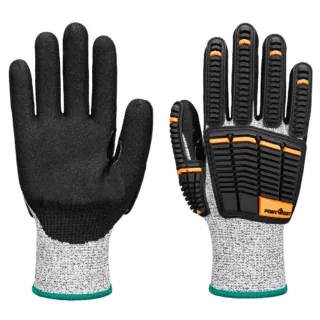


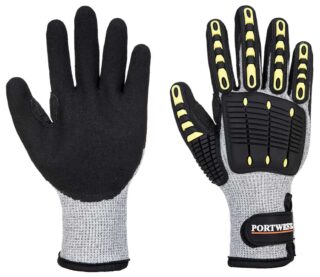

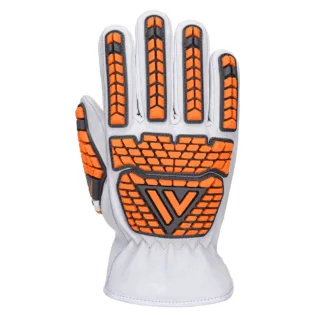

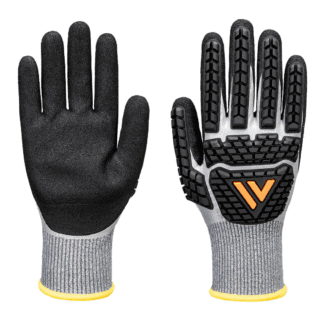

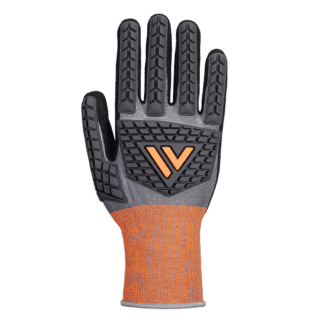

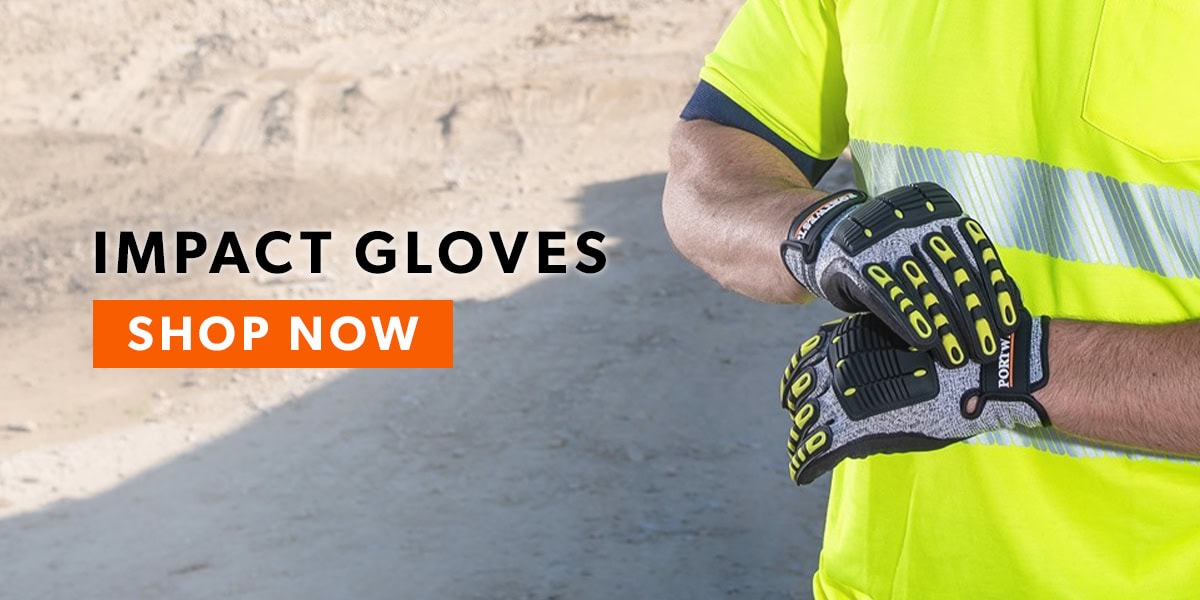
In industrial environments, the hand is constantly near forces it wasn’t built to absorb: a pipe wrench slipping under load, a chunk of loose rock falling from a face, a hammer glancing off a bolt head. Yet these are routine smash hazards of construction, oil and gas, mining, and heavy manufacturing face every day.
The injuries they cause range from soft tissue bruising to metacarpal fractures, and they share a common mechanism: blunt kinetic energy transferred to the dorsal surface of the hand faster than the body can respond. Impact-resistant gloves, sometimes called impact gloves or anti-impact safety gloves, exist to interrupt that energy transfer before it causes damage to your hand.
For most of their history, impact gloves weren’t specifically regulated. General-purpose safety gloves were evaluated under standards like EN 388, which tests cut, abrasion, tear, and puncture resistance but doesn’t mention dorsal impact specifically.
ANSI/ISEA 138, introduced in 2019, is the first dedicated standard for back-of-hand impact protection, and its methodology is precise: A 2.5 kg guided mass is dropped onto the knuckle and finger areas of the glove with 5 Joules of energy. The metric is Mean Transmitted Force (MTF), measured in kilonewtons (kN). MTF measures how much of that 5-Joule strike passes through the glove material to the hand beneath. The lower the transmitted force, the better the protection.
The standard tests multiple zones, including knuckles, fingers, and thumb, and the glove’s worst-performing area determines its overall rating. A glove that achieves Level 3 performance across the knuckles but only Level 1 at the fingers is rated Level 1. This prevents manufacturers from focusing on a single zone while leaving others underprotected.
EN 388 includes an impact test in its most recent revision, but it remains a pass/fail assessment rather than a tiered performance metric. ANSI/ISEA 138’s three-level MTF scale provides a quantified, comparative basis for selection.

One point the standard does not change: Impact-resistant does not mean crush-proof. ANSI/ISEA 138 defines protection against dynamic strikes, like a falling object or a sudden blow. It doesn’t address performance under a sustained compressive load, such as a hand caught between two heavy surfaces. The physics are different, and no glove rating currently addresses quasi-static crush force. Workers in high-pinch environments need to understand this distinction
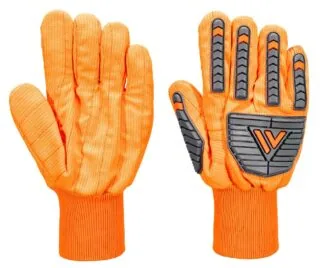
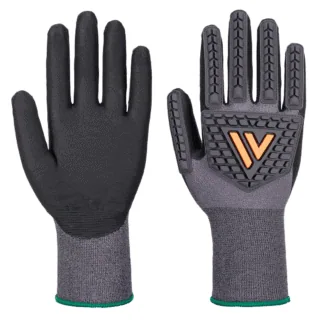
The exterior of an impact glove is typically described as an exoskeleton: a structured dorsal shell that redirects and disperses kinetic energy before it reaches bone and tissue. The materials used to build that shell fall into two categories.
Thermoplastic Rubber (TPR)
Thermoplastic Rubber (TPR) is injection-molded into segmented guards — finger bumpers, knuckle caps, thumb saddles — and bonded or stitched to the glove’s outer layer. With TPR, the rigid, convex profile of each guard distributes the contact area of a strike, converting a concentrated point load into a broader pressure wave that dissipates across a larger surface.
The material itself has moderate energy absorption, but its durability, low cost, and moldability make it the standard choice for Level 1 and Level 2 applications. TPR guards are also replaceable in some glove designs, extending their lifespan.
D3O® and Poron XRD®
D3O® and its sibling, Poron XRD®, are non-Newtonian materials; their viscosity is rate-dependent, meaning their physical behavior changes with the rate at which force is applied. Under slow, low-rate deformation like normal hand movement, gripping, or flexing, the molecular chains within these materials flow freely, keeping the glove soft and flexible. Under high-rate impact, those same chains lock together almost instantaneously, creating a rigid network that absorbs and dissipates kinetic energy before it can transmit to underlying tissue.
Reportedly, D3O® can absorb up to 90% of impact energy under test conditions. Because it returns to its flexible state immediately after impact, it doesn’t degrade the way conventional foam padding does after repeated strikes. Thinner and lighter than equivalent-performing TPR gloves, these materials are the preferred choice where dexterity is non-negotiable.
To receive a full ANSI/ISEA 138 rating, protection must cover the knuckles, all finger zones, and the thumb. Partial coverage, common in lower-cost designs that protect only the knuckle bar, cannot earn a rated classification under the standard.
The three ANSI/ISEA 138 performance levels correspond to particular industrial hazard profiles, with MTF thresholds that reflect the severity of expected impact forces:
Level 1 (MTF ≤ 9.0 kN)
Appropriate for environments where impact risk is incidental rather than primary, like light assembly, general maintenance, and material handling involving hand tools and moderate-weight components. This requires light protection, and Level 1 gloves typically offer the best dexterity-to-protection ratio.
Level 2 (MTF ≤ 6.5 kN)
Works in environments with regular exposure to moderate impact hazards, such as construction and infrastructure work, automotive assembly, and similar trades. This is the most common specification tier for general-purpose industrial impact gloves.
Level 3 (MTF ≤ 4.0 kN)
Reserved for the highest-hazard environments. Oil and gas operations, particularly drilling and rigging, involve heavy pipe, high-torque wrenches, and equipment under tension, all of which create severe crush and strike risk. Mining and heavy demolition also apply, with blunt force from moving mechanical parts, loose rock, and large-scale hand-tool use. Level 3 gloves have thicker TPR, D3O® or Poron XRD® inserts, or both.
Impact protection is only as effective as the fit that keeps it in place. A knuckle guard that sits 5mm off-center because the glove is too large won’t protect the hand the way the design intends. Proper sizing is a safety must.
There is a trade-off between protection level and dexterity. Thicker TPR constructions, particularly Level 3 designs, reduce grip sensitivity and fine motor control. For tasks that require precise hand positioning and impact protection, D3O® and Poron XRD® materials provide equivalent or superior energy absorption with far less bulk. If those materials are unavailable or cost-prohibitive, Level 2 TPR gloves with articulated, segmented guard designs (rather than solid dorsal shells) allow for more natural hand movement.
Be mindful of inspection intervals, as well. TPR guards can crack or delaminate with repeated high-force impacts, and non-Newtonian inserts can shift within their housings if stitching degrades. A glove that has absorbed a significant strike should undergo inspection before it returns to service; visible deformation or separation of the guard from the liner is cause for replacement.

Stay on top of the latest news about prescription safety glasses, eyewear, sunglasses, and all the trends in the industry.
DISCOVER NOWBe the first one to know about promotion, new products, and more.
Follow Us On Instagram @rx_safety