Every time you ride your motorcycle, you rely on your eyesight to keep you safe. As you age, though, you may notice that your eyes don’t focus as well on nearby objects. You might see a car switching lanes ahead on the highway, but your speedometer or GPS mount looks blurry. This natural vision change, called presbyopia, often affects people over 40.
Bifocal glasses can help manage this change, but you can’t always look down through the lower part of your lenses while cruising at 70 mph. This guide shares the best bifocal types for motorcycle riders and how to choose the safest option.
Everyday bifocals have lenses divided into two zones by a visible line. The upper zone corrects distance vision, while the lower zone helps you see objects up close. For example, you might look down to read a book, then tilt your head back to focus on someone across the room.
On a motorcycle, that sort of head movement can be downright dangerous. Tilting your head back at the wrong time could make it harder to spot an animal or pothole in your path. Meanwhile, leaning forward to read your speedometer could affect your situational awareness or even make you drift out of your lane.
The risk is even greater when riding on the highway, where quick reactions can make all the difference. That’s why choosing the right motorcycle riding bifocals matters just as much as picking a well-fitting helmet.
Wearing bifocals while riding your motorcycle doesn’t have to feel awkward or unsafe. Several lens designs can help you keep everything in focus, so you can feel more confident on the road.
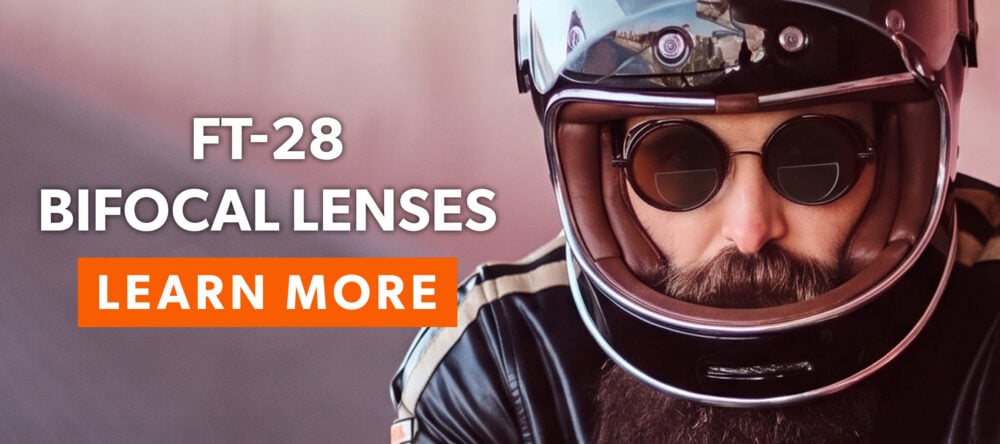
Flat Top 28 motorcycle glasses are one specialized option. They have a small, 28 mm D-shaped reading window near the bottom of each lens, which takes up less space than the reading segment on traditional bifocals.
This design eliminates the “fishbowl” effect and peripheral distortions that occur with regular bifocals. Your vision stays clear, whether you’re looking at something nearby or down the road. This allows you to check your blind spots and look over your shoulder for lane changes more comfortably.
If you’d rather have no lines at all, consider progressive lenses. You can look through different parts of the lens to see a billboard down the road, your handlebars, or your speedometer.
One of the biggest differences between progressive vs bifocal motorcycle riding is that progressives give you more intermediate vision. However, that area is pretty narrow, so you may need to turn your head to see your dashboard or nearby traffic clearly. That can be inconvenient, especially if you’re wearing a bulky helmet.

For a quick and convenient fix, StickToIt stick-on bifocal lenses are worth considering. They’re removable and reusable lenses that attach to the inside of your regular glasses or sunglasses. They might help if you break your regular glasses on a road trip or need a budget backup.
Unlike prescription motorcycle bifocals, stick-on lenses don’t provide the same level of visual coverage, which may result in blurry spots. They’re also not designed for driving, so you should save them for stationary activities like checking your GPS while parked.
Choosing the right bifocals matters, especially when you’re riding a motorcycle. Here are a few factors to consider:
Your riding posture and bike style: Do you sit upright on a cruiser, or do you lean forward in an aerodynamic sport bike tuck? Or maybe you spend a lot of time leaning into turns on winding roads. Each posture changes your head position. Look for a bifocal lens that matches your natural sight line so you’re not constantly readjusting.
Bifocal segment height: Optometrists usually measure bifocal segment height in a standard setting, but that position may not work as well on a motorcycle. For the correct measurement, sit on your bike in your usual riding position and ask your optometrist to find the right placement for the reading segment. If it’s too high, the road ahead might look blurry.
Intermediate vs. near needs: Presbyopia doesn’t affect everyone the same way. Some people may only need help to see an illuminated speedometer a foot away, while others might want to read tiny text on a GPS route map.
Peripheral awareness: When you’re riding fast, you can’t afford to have distorted peripheral vision. Look for glasses that let you see clearly when you glance in the mirror or at cars beside you.
With the right bifocal lenses in mind, you’re ready to start shopping. Look for these features:
A flying rock or bug hitting your glasses at 80 mph is the last thing you want. Protect your eyes by choosing ANSI Z87.1-certified safety glasses made from polycarbonate or Trivex.
Riding a motorcycle can quickly dry out your eyes, especially at high speeds. Foam gaskets or wraparound frames help block the wind.
Avoid bulky glasses, which may press into your face under a helmet. Instead, look for bifocals with thin, straight temples that easily slide under your gear.
Anti-fog coatings will help keep your lenses clear on chilly mornings and at stoplights. Transitions (also known as photochromic lenses) could also be useful if you frequently move between sunny and dark spaces.
You don’t have to hang up your helmet just because your near vision isn’t as sharp as it used to be. The right lenses give you the clear vision you need to ride safely.
FT-28 lenses are a good option for scanning the highway without much distortion. If you need help seeing instrument dashboards at different distances, consider progressives. No matter which option you choose, ensure to get a custom measurement, so your line of sight isn’t blocked.
Get ready for your next ride by exploring RX-Safety.com’s collection of custom prescription motorcycle glasses, bifocals, and ANSI-certified riding eyewear.


Stay on top of the latest news about prescription safety glasses, eyewear, sunglasses, and all the trends in the industry.
DISCOVER NOWBe the first one to know about promotion, new products, and more.
Follow Us On Instagram @rx_safety