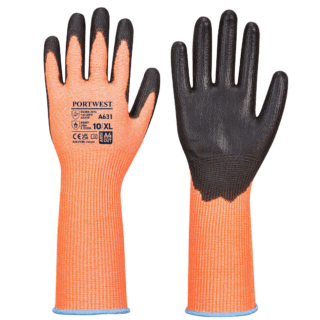
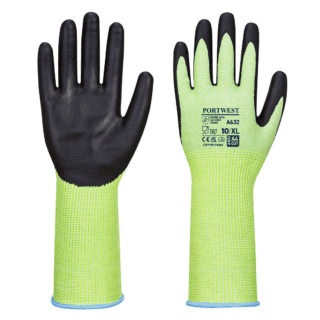


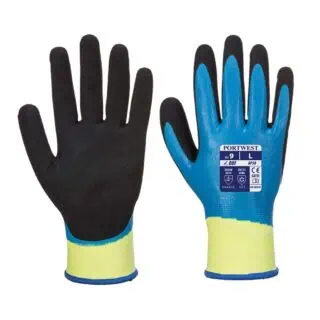
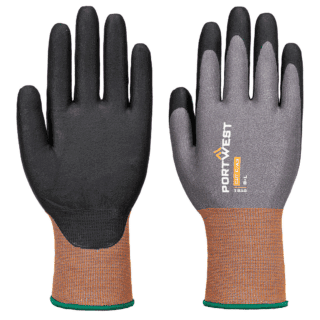
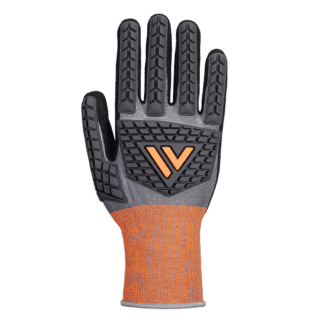

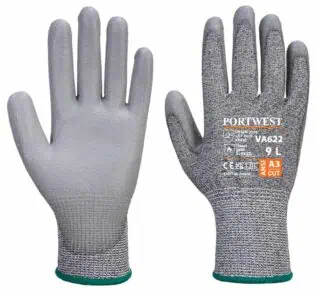

Cut resistance is not a single property; it’s a combination of several interacting material behaviors. Essentially, cut resistance describes a material’s ability to withstand mechanical shear: the lateral force a blade exerts as it drags across a surface. Unlike puncture or abrasion, shear failure occurs when a blade’s edge concentrates stress along a narrow contact zone until the network of fibers can no longer distribute that load.
The engineering behind cut resistance is worth examining in detail.
The performance of cut-resistant gloves begins with the yarn selection. The three major types used in cut-resistant safety gloves are para-aramids, high-performance polyethylene (HPPE), and composite yarns.
Commercially known as Kevlar® and Twaron®, para-aramids are cut-resistant due to their molecular structure. In para-aramid polymers, amide bonds link rigid aromatic rings in a fully extended, co-linear chain configuration. Due to this alignment, individual chains can pack tightly into crystalline domains, fused by dense hydrogen bonding. The result is a fiber with a tensile strength roughly five times that of steel by weight, and a molecular stiffness that resists the lateral displacement of a cutting edge that requires severing the structure.
Para-aramids are also inherently flame-resistant. They don’t melt or drip, and they retain structural integrity at temperatures where most synthetics fail. For this reason, they’re the default choice in automotive assembly, welding, and metal stamping environments where thermal exposure is also a hazard. They do, however, absorb moisture and degrade under prolonged UV exposure, which limits their service longevity in certain outdoor environments.
HPPE, sold under brand names like Dyneema® and Spectra®, achieves its cut resistance through ultra-high molecular weight polymer chains that are gel-spun and drawn into near-perfect crystalline alignment. This process produces fibers with an exceptionally high degree of orientation and eliminates the amorphous areas where failure can occur.
This material is approximately 15 times stronger than steel at an equivalent weight; this strength-to-mass ratio lends itself to lightweight, high-cut-level applications. It is also chemically inert and hydrophobic, shedding moisture rather than absorbing it, an advantage in food processing and other wet environments. HPPE’s biggest limitation is a relatively low melting point (about 147°C), making it unsuitable for work sites with thermal hazards.
Composite yarns combine these base fibers with reinforcing elements, such as stainless steel filaments, fiberglass strands, or ceramic particles, to achieve performance neither polymer can reach alone. A steel core blocks blade penetration, while the abrasive surface texture of fiberglass strands accelerates blade dulling, reducing the blade’s effectiveness with each pass.
The outer wrap of HPPE or para-aramid preserves the yarn’s knittability and wearer comfort. The downside is weight and tactile sensitivity, both of which become less ideal as the composite becomes more complex.
Determining the performance of cut-resistant gloves requires standardized testing. Cut resistance describes a material’s capacity to protect against blade penetration under set conditions, not to prevent it indefinitely. With that established, ANSI/ISEA 105 and EN388 are the two standards, each of which measures cut resistance differently.
This test uses the TDM-100 (Tomodynamometer) test machine. The operator loads a circular blade with a known weight before rolling it across a flat, mounted glove sample under constant force. The test measures the gram-load required to cut through the material in a single pass.
The results, presented in grams, are classified into 9 cut levels (A1 through A9), which range from 200 grams (A1) to over 6,000 grams (A9).
This standard employs the Coup Test, in which a rotating circular blade passes back and forth over a glove sample under a fixed 500-gram load. The metric is the number of cycles completed before cut-through, expressed as an index relative to a standardized cotton reference. The result is a letter grade from A through F.
EN 388 also incorporates a second method, the ISO 13997 TDM test, which is used when the blade dulls on high-performance materials. This can occur during the Coup Test when testing fibers such as HPPE and para-aramids. This supplemental test measures the force in Newtons required to cut through the material over a 20mm blade travel, providing a more stable metric for engineered fibers. When the second test is necessary, the results include the Coup result and a letter rating derived from the TDM test. This adds nuance, but also complexity, to cross-standard comparisons.
The cut-resistant fibers protect against shear force, but safety gloves also need to maintain control of the objects you handle. Coatings applied to the palm and fingers determine the coefficient of friction (CoF) between the glove surface and the item in hand.
Nitrile coatings provide a high CoF on both dry and oily surfaces due to their microporous or foam structure, which mechanically interlocks with surface irregularities. Nitrile adds a secondary layer of cut resistance and is also resistant to oils, fuels, and many solvents.
The trade-off is that nitrile makes gloves less breathable and reduces dexterity compared to thinner coatings.
Polyurethane (PU) coatings are thin films that preserve the tactile sensitivity of the underlying liner. PU provides a good grip on dry and lightly oily surfaces. It is the preferred coating for tasks that require fine motor skills, such as electronics assembly. It contributes little to cut resistance, though, and it is not appropriate for heavily contaminated environments.
Latex coatings have the highest CoF of the three types on wet surfaces and offer strong abrasion resistance. The textured finish effectively grips irregularly shaped objects.
Latex commonly causes allergic reactions, so you shouldn’t use it in workplaces where latex allergies are a concern. It also degrades under hydrocarbon exposure.
Before selecting the proper material for your cut-resistant gloves, consider your work environment. This table links common industrial tasks to the appropriate glove material and coating combinations.
| Task/Environment | Primary Hazard | Recommended Fiber | Recommended Coating |
|---|---|---|---|
| Dry glass handling | Sharp edges, shear | Para-aramid or HPPE (A6+) | PU (dry grip, dexterity) |
| Oily sheet metal fabrication | Shear, oil contamination | HPPE or composite (A4–A6) | Nitrile foam |
| Stamping/press operations | Shear, impact | Composite with steel core (A7+) | Nitrile |
| High-temperature metal handling | Thermal, shear | Para-aramid/Kevlar (heat-stable) | None or heat-rated nitrile |
| Light assembly/ electronics | Minor shear | HPPE/Dyneema (A2–A3) | Thin PU |
| Wet fish or meat processing | Shear, moisture | HPPE (hydrophobic) | Latex or nitrile |
| Meat processing/ pulp and paper | Maximum mechanical barrier | Steel mesh (ANSI A9 equivalent) | None (mesh construction) |

Stay on top of the latest news about prescription safety glasses, eyewear, sunglasses, and all the trends in the industry.
DISCOVER NOWBe the first one to know about promotion, new products, and more.
Follow Us On Instagram @rx_safety