



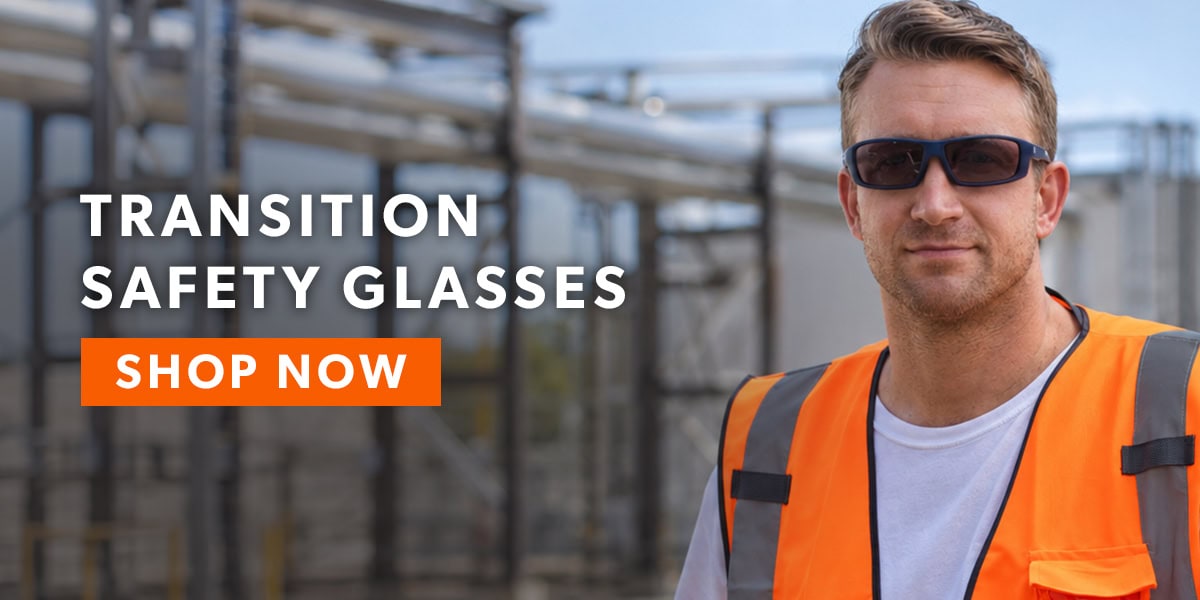
If you spend a lot of time moving between the indoors and outdoors, protective eyewear can feel like a hassle. You’re constantly carrying around two different pairs of safety glasses: clear for indoors and tinted for outdoors.
There’s an easier way. Transition (or photochromic) lenses automatically adjust to the lighting conditions, so you can wear them wherever you go. This guide breaks down how they work and the pros and cons of transition lenses for safety glasses.
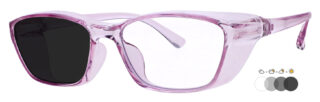
Photochromic safety glasses are typically made with special dyes that react to ultraviolet (UV) light. The lenses automatically darken when you step out into the sunlight, then go back to clear when the UV exposure decreases.1
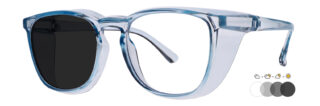
Lenses remain clear when UV exposure is low.
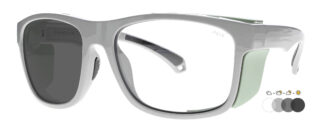
Lenses darken in response to sunlight and UV exposure.
Some safety glasses combine photochromic lenses with ANSI Z87.1-rated frames and lenses. This gives you certified impact protection and automatic light adjustment in one pair. That’s especially useful if you spend a lot of time moving between different lighting conditions. For example, if a mechanic wears transition lenses, their glasses would be clear while they’re working inside the garage, then darken when they step outside to inspect a car.
There are plenty of practical reasons to choose ANSI Z87.1 transition glasses.
Convenience is a big one. You only need one pair of prescription safety glasses throughout the workday. No more lugging around two sets and switching between them all day.
Having just one pair also makes it easier to keep track of your glasses. You’ll spend less time searching around the job site to find them, and you’re less likely to tell yourself, “I’ll be careful this time,” and go ahead without them.
Glare reduction is another major perk. You’ve probably stepped outside on a bright job site or loading dock and immediately had to shield your eyes. With transition lenses, your glasses automatically adapt to bright light. That cuts down on harsh glare and helps you see more comfortably when you go from inside to outside.
Light-reactive safety glasses also block UVA and UVB radiation. That gives you continuous 100% UV protection throughout the day, reducing eye strain and helping prevent UV damage that can lead to eye conditions such as photokeratitis2 and cataracts.3
Transition lenses make it easier to stay compliant with safety regulations too. You’ll be much less likely to take off your protective eyewear when you walk outside if your lenses automatically adjust to the sunlight. So if something unexpected happens, you’re less likely to be caught without eye protection.
And don’t forget about the cost savings. High-quality prescription transition safety glasses may have a higher price tag than regular ones. However, it’s often more economical to buy a single pair than to purchase two separate pairs of custom prescription frames.
While transition lenses have many benefits, they’re not right for everyone.
Standard photochromic lenses mostly rely on direct UV exposure to darken, and windshields are designed to block much of that UV radiation, so the lenses may not fully darken inside a vehicle. That’s a problem if, for example, you’re driving a forklift from a dark warehouse to a bright loading dock.
Instead, you can look for specialty lenses like Transitions® XTRActive, which are designed to get darker in vehicles than regular photochromic lenses. If you spend a lot of time driving trucks or heavy machinery, this might be a good option.
Another downside is that transitions aren’t instant. Lenses usually darken in 30 to 60 seconds, so you’ll get quick relief from glaring sunlight. However, it could take two to five minutes for them to go back to completely clear when you walk inside. So if you work in a dim warehouse or mechanical room, you might need to pause inside the doorway while your lenses adapt.
The temperature also plays a role in how photochromic lenses work. Photochromic molecules tend to get darker than normal in cold weather, but they may not get as dark in intense summer heat. So if you work in extreme temperatures, you might prefer the consistency of ordinary safety glasses.
The initial cost is another drawback. Custom prescription transition safety glasses are often more expensive than standard clear ones, though they may still be cheaper than buying two separate pairs for indoors and outdoors.
If you’re considering transition lenses for workplace safety, think about how they might fit into your daily routine.
These lenses could be a good fit for people who spend a lot of time on the go, such as:
On the other hand, you might prefer two separate pairs of glasses (one tinted and one clear) if:
If you decide to try transition lenses, look for safety glasses with polycarbonate or Trivex lenses that meet ANSI Z87.1 impact requirements. That way, you can enjoy adaptive lenses while still getting the eye protection you need.
There’s nothing more annoying than squinting into the sunlight or having to swap safety glasses every time you walk outside. Safety glasses with transition lenses adjust to your surroundings, so you get continuous eye protection.
Like any eyewear, transition glasses come with a few trade-offs. However, they might be worth it if you frequently move between indoor and outdoor tasks and need one pair that adapts wherever you go.
Rx-Safety lets you customize your prescription safety glasses with Transitions®, Transitions® XTRActive, or polarized options. Explore our online catalog to design a pair that fits your work needs.
Sources:
Stay on top of the latest news about prescription safety glasses, eyewear, sunglasses, and all the trends in the industry.
DISCOVER NOWBe the first one to know about promotion, new products, and more.
Follow Us On Instagram @rx_safety