


Many people assume that safety glasses protect their eyes from UV radiation. While that’s typically true, they don’t always offer as much protection as you think, and plastic doesn’t necessarily block UV light.
In fact, a large share of lenses marketed as “UV protected” still leave measurable gaps in the spectrum. This means some of the most damaging radiation could still reach your retina. Without full-spectrum protection, you could face an increased risk of health conditions like cataracts and macular degeneration.
So, what kind of safety glasses with UV protection do you need? The answer begins with understanding the UV spectrum and how it affects the eyes.
Ultraviolet radiation is a spectrum of light that lies just beyond what’s visible to us. It’s measured in nanometers (nm) and divided into three major bands.
UVC (100 to 280 nm)
is the most energetically intense form of UV light. But humans are rarely exposed to it at ground level. The Earth’s ozone layer absorbs virtually all UVC before it reaches us. So you don’t have to worry about finding UVC protection in a pair of prescription safety glasses.
UVB (280 to 315 nm)
is the band of light that can cause a sunburn of the cornea, or photokeratitis. Welders often refer to this as “arc eye.” It’s also something skiers and high-altitude workers encounter from reflected snow and increased UV intensity at elevation. Even brief exposure to UVB can cause temporary vision loss and intense eye pain.
UVA (315 to 400 nm)
is a more subtle light, but also where long-term damage can quietly accumulate. UVA rays penetrate deeper into your eye, reaching all the way to the lens and retina. Chronic exposure can lead to cataracts and macular degeneration, which are two of the leading causes of permanent vision impairment.
UVA doesn’t trigger the immediate discomfort that UVB does, which makes it easy to underestimate until the damage has already been done.
Polycarbonate has become the dominant material in safety lenses. It’s lightweight, impact-resistant, and naturally absorbs UV radiation. However, the UV-absorption properties of polycarbonate top out around 380 nm.
Because UVA radiation extends up to 400 nm, a standard polycarbonate lens with no additional treatment still allows 20 nanometers of high-energy radiation to reach your eyes.
Twenty nanometers may sound trivial, but it’s within the 380 to 400 nm band that contains some of the highest-energy UV rays. Exposure within this range can accumulate over time, leading to serious visual issues down the road.
So, even when a manufacturer calls their safety glasses “UV protected,” it doesn’t mean they’re all you need to stay safe. You still have to verify the spectrum of UV rays that the glasses guard against before you can truly rely on them.
The standard you should look for instead is a UV400 rating. This means the eyewear blocks all UV radiation from 100 nm up to 400 nm — including UVC, UVB, and the full UVA spectrum.
Manufacturers have to go beyond the natural properties of polycarbonate to reach UV400 performance. They typically do so by infusing the lens material with additional UV-absorbing compounds or by applying a specialized coating to the surface of the lens.
This also applies to prescription safety glasses. If you’re using corrective lenses in your safety frame, they still need to carry a UV400 rating for full protection. The prescription grinding process doesn’t add any additional UV protection.
A common myth is that a darker lens means better UV protection. But that’s not based on fact. Tint is an optical property, whereas UV protection is a chemical and material property. The two are entirely independent things.
In fact, a dark lens without UV400 treatment can actually be more dangerous than an untreated clear lens. This is because darkness causes the pupils to dilate, which allows more light into the eye. You could have more UV radiation reaching your retinas.
On the flip side, a clear lens with UV400 protection provides everything you need. You may not guess it from looking at clear glasses, but that’s why checking the UV rating matters more than appearance.
Never assume that tint levels indicate UV protection levels. You should always look for the UV400 designation, regardless of how a lens looks.
Full UV400 protection is better than generic “UV protected” stamps. However, the hazardous zone doesn’t end there. Light in the 400 to 450 nm range can also be dangerous.
This range falls into what’s called high-energy visible (HEV) light. Or, more commonly, blue light. It’s right at the boundary between UV and visible light, and still carries enough energy to cause cumulative retinal stress. Research has linked chronic HEV exposure to eye strain, disrupted circadian rhythm, and increased risk of age-related macular degeneration.
Safety glasses with UV400 protection sometimes incorporate additional coatings to block blue light. You may want to look for these if you are exposed to significant amounts of artificial light on the job, such as staring at a screen for long periods.
HEV protection is not a replacement for UV400. They complement one another, each blocking a different spectrum of light that could damage your visual system over time.
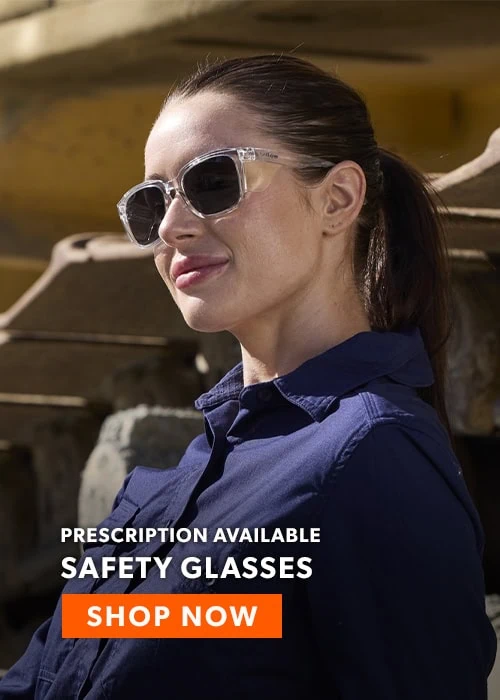
Safety glasses and UV protection are not an either-or. There’s a spectrum of rays that can damage the eyes, and you want safety glasses that will protect you against all of them.
That means choosing UV400 over more generic labels like “UV protected” or “UV resistant.” Both of these are technically true, but neither is the standard that matters for keeping your eyes safe. Don’t judge by tint, either. Dark lenses can actually be more dangerous, given the way they dilate pupils.
Ultimately, remember that damage from UV and HEV often accumulates quietly in the background over years. Full-spectrum protection is worth prioritizing, even if you don’t notice any eye soreness today.
RX-Safety carries the prescription safety glasses with UV protection you need to stay safe. You can review our full catalog of glasses for environments like construction sites and research labs, and customize your prescription in just a few clicks.
Stay on top of the latest news about prescription safety glasses, eyewear, sunglasses, and all the trends in the industry.
DISCOVER NOWBe the first one to know about promotion, new products, and more.
Follow Us On Instagram @rx_safety