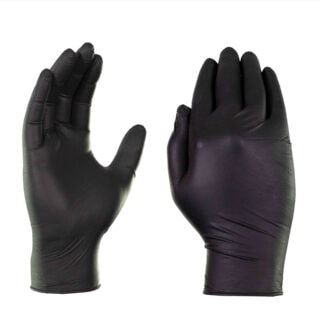
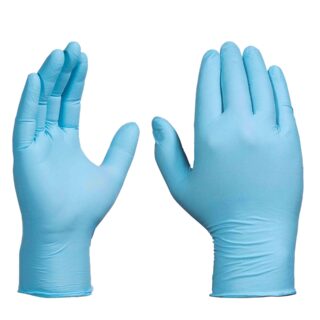
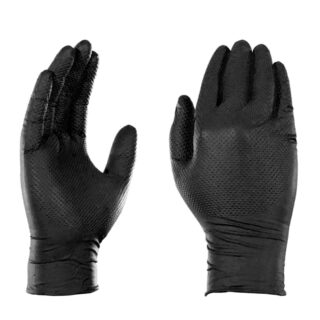
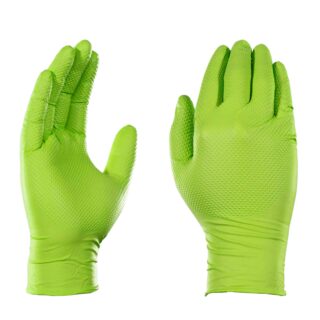
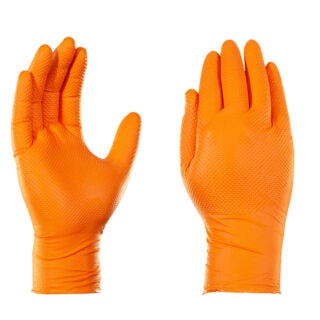
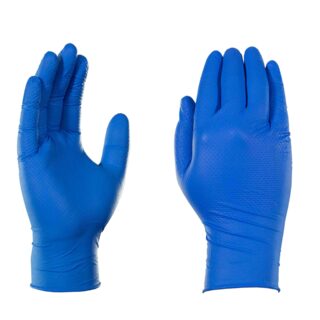
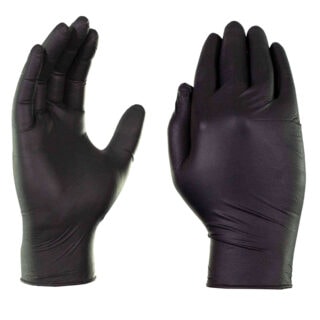
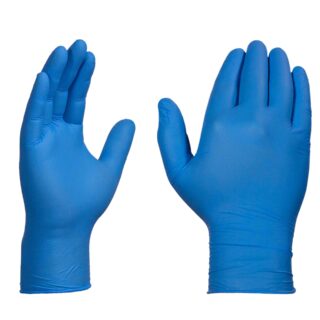
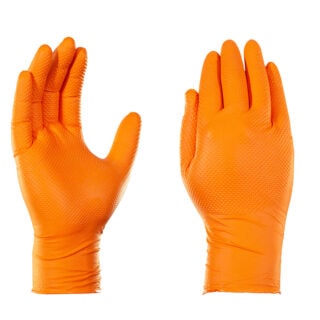


Professionals across industries rely on disposable gloves to protect themselves from contaminants or to prevent the spread of germs. While latex gloves are a popular option, they’re not always suitable.
Nitrile gloves are a strong alternative. They even outperform latex gloves in durability and shelf life. Across industries like healthcare, automotive, food service, and manufacturing, nitrile gloves are a compelling option for disposable safety gloves.
Nitrile butadiene rubber, often shortened to NBR or nitrile, is a synthetic, latex-free rubber. It’s a petroleum-based “elastomer.” Latex, by contrast, is a natural material that comes from trees.
Nitrile is made in a lab, which means the produced raw material is more consistent and stable than natural latex. Since natural latex is produced by tapping rubber trees, collecting the fluid, and letting it harden into rubber, there’s often some batch-to-batch variation in the final product. That’s not an issue with nitrile.
The synthetic manufacturing process involves copolymerizing acrylonitrile and butadiene, typically via emulsion polymerization. Acrylonitrile provides the chemical resistance and stiffness that make nitrile gloves effective safety gear. Butadiene gives the gloves their flexibility and tear resistance, allowing the wearer to maintain dexterity.
The manufacturers will combine acrylonitrile and butadiene in water, using an emulsifier and activators to initiate polymerization. At a controlled temperature, the polymerization reaction continues for hours. The result is a latex suspension.
Next, the manufacturers will filter the latex suspension and add coagulants to form a solid. They wash the coagulated rubber to get rid of any remaining impurities and then dry it to get nitrile rubber sheets or bales. The final steps in producing nitrile gloves are compounding the nitrile and vulcanizing it to improve elasticity and durability.

When your business requires disposable gloves, choosing between latex and nitrile can be challenging. Understanding the key differences between them will make it easier to select the right option for your needs based on safety, durability, and other important factors.
Use this head-to-head comparison of nitrile vs latex gloves.
| Nitrile | Latex | |
| Puncture Resistance | High | Moderate |
| Allergy Risk | Very Low | High |
| Tactile Sensitivity | Very good, close to latex | Excellent |
| Durability | High | Moderate |
| Flexibility | Slightly lower | High |
| Shelf Life | Longer | Shorter |
One of the main reasons that business leaders look for alternatives to latex gloves is the risk of allergic reactions. Millions of people across the United States have latex allergies that may make using latex gloves uncomfortable or even dangerous.1 That’s a risk you may not want to take in your business.
Nitrile gloves, like those from Rx-Safety, do not contain latex, so there’s a very low risk of an allergic reaction in the wearer.
While nitrile gloves are slightly less flexible and offer less tactile sensitivity, they make up for that in improved durability and puncture resistance. Nitrile is three to five times more puncture-resistant than latex. In environments where contamination prevention is the primary concern, nitrile gloves are likely a better option than latex gloves. Nitrile is highly resistant and won’t break down as easily as latex when exposed to oils, fuels, and chemicals.
And when nitrile does get punctured, it often tears completely. These large tears make it easy for the wearer to notice the issue immediately and replace the gloves. By contrast, latex gloves are prone to microscopic pinholes that compromise safety without the wearer ever knowing.
Latex gloves are often less expensive than nitrile gloves, which is another factor to consider.
When comparing disposable glove options, look for key features like:
Textured fingertips
Added texture on the fingertips improves grip.
Beaded cuffs
An extra lip around the cuff of the gloves protects the wearer from liquids dripping down.
Powder-free finishes
Lack of powder makes gloves less risky in medical applications.
When shopping for nitrile gloves, there are certain symbols and certifications to look out for. Learning these safety certifications will help you choose the best gloves for your requirements.
AQL stands for acceptable quality level. With nitrile gloves, the AQL measures how well the gloves protect against holes, tears, and other weaknesses. A higher AQL indicates a lower level of protection.2
For example, nitrile gloves with an AQL of 4 generally offer less protection than gloves with an AQL of 1.5. Medical-grade gloves have an AQL of 1.5 or lower, meaning fewer than 1.5% of gloves in a batch can fail a water leak test.
The ASTM D6319 is the standard that nitrile examination gloves must meet for medical applications.3 To meet this standard, the gloves cannot have powder residue, must meet certain dimensions, and must pass tests for pinholes. Do not rely on AQL alone to find gloves suitable for medical use. Nitrile gloves labeled ASTM D6319 are rigorously tested to ensure they’re safe in medical environments, while others may not be.
EN 374 is the European standard for single-use medical gloves. Gloves that meet this standard go through testing for holes, specific physical properties, and shelf life to demonstrate that they protect the wearer from dangerous chemicals and microorganisms.4 If you’re using protective disposable gloves because of chemical or germ concerns, choosing nitrile gloves labeled EN 374 may be the best option.
Nitrile is a material, not something that’s proprietary to one brand or manufacturer. So, there’s no generic alternative to nitrile that’s less expensive.
However, nitrile gloves fall into specific grades that indicate quality and tell you which uses they’re suited to.

Industrial grade
The lowest grade with more allowed defects, ideal for manufacturing and cleaning

Food grade
Higher protection levels, controlled for contaminants that are not safe for human consumption, suitable for food processing

Medical grade
Highest levels of protection, strictly monitored, safe for surgical procedures
Generally, higher grades of nitrile gloves are more expensive, since they adhere to stricter standards. While medical grade is the highest and sounds best, it’s not always necessary, depending on how you plan to use the gloves.

Sources
Stay on top of the latest news about prescription safety glasses, eyewear, sunglasses, and all the trends in the industry.
DISCOVER NOWBe the first one to know about promotion, new products, and more.
Follow Us On Instagram @rx_safety