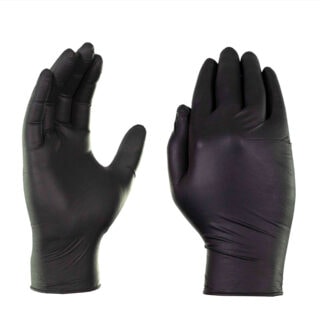



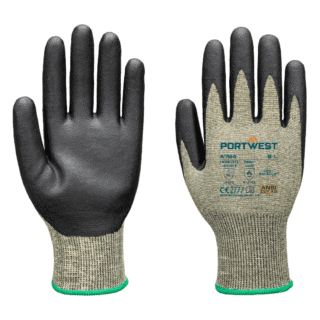




When does OSHA mandate that safety gloves should be worn in the workplace? Under 29 CFR 1910.138 (Hand Protection), OSHA (the Occupational Safety and Health Administration) requires employers to mandate appropriate hand protection anytime workers face hazards that engineering or administrative controls cannot eliminate.
OSHA divides the standard into two components:
This section dictates that employers must provide appropriate hand protection and require workers to use it whenever workplace hand hazards exist.
In this section, OSHA states that employers cannot choose hand protection arbitrarily and must instead conduct a workplace risk assessment, evaluating the gloves’ characteristics against the job’s specific hazards, tasks, conditions, and duration.
Hand and finger injuries, including cuts, punctures, and burns, are one of the most common and costly workplace injuries in the U.S. According to the Bureau of Labor Statistics, these account for approximately 20% of disabling or recordable job-related injuries, which is exactly why observing OSHA safety glove requirements is essential.
The OSHA 1910.138 hand protection standard requires employers to mandate appropriate hand protection when hazards are present.
Five primary categories of hazard conditions necessitate OSHA glove compliance:
OSHA 29 CFR 1910.138 mandates gloves for the first four categories, while a separate OSHA standard, 29 CFR 1910.1030 (Bloodborne Pathogens), covers the fifth category.
To determine if hazards are present, another OSHA standard, 29 CFR 1910.132(d) (General Requirements), requires employers to assess the workplace for possible hazards and document the evaluation with a Written Certification of Hazard Assessment. This standard requires employers to use the NIOSH Hierarchy of Controls framework, applying engineering solutions, like machine guards and ventilation, to try to eliminate the hazards before relying on safety gloves as a last resort.

The wrong safety gloves can be just as dangerous as wearing no gloves at all. For example, permeable fabric gloves offer no protection against hazardous solvents. They can even worsen chemical burns by trapping caustic substances against the skin, creating prolonged, concentrated exposure that causes more damage than a quick splash on bare skin.
Under OSHA safety glove requirements, protective gloves typically fall into four primary material categories based on their construction and hazard protection.
These chemical- and liquid-resistant gloves, made from various natural or synthetic rubbers and plastics, protect against hazardous chemicals, solvents, acids, and caustics. Gloves for food service and medical personnel also fall under this category (usually nitrile or PVC, depending on the precise task).
Some professions that wear this glove category include:
Kevlar and HPPE (High-Performance Polyethylene), both high-performance synthetic yarns, offer exceptional cut resistance. Kevlar is also inherently flame- and heat-resistant, while HPPE is incredibly lightweight and cool to the touch.
Workers often wear these gloves in:
Designed for general handling, these durable gloves help shield your hands from sparks, moderate heat, rough surfaces, dirt, splinters, and chafing.
These gloves protect workers in:
In 29 CFR 1910.137 (Electrical Protective Equipment), OSHA mandates that safety gloves should be worn when performing high-voltage electrical work. Dielectric rubber insulating gloves protect workers from electrical shock and arc flash hazards when working on or near energized circuits.
Various workplaces require dielectric gloves, including:

OSHA’s workplace hand protection standards enforce an entanglement exception through standard interpretations and the General Duty Clause found within Section 5(a)(1) of the Occupational Safety and Health (OSH) Act of 1970. OSHA prohibits or strongly advises against wearing gloves when operating high-RPM rotating machinery, such as drill presses, lathes, mills, bench grinders, rollers, spindle sanders, and transport conveyors. In these conditions, a glove may catch on a spinning part and pull the operator’s hand and arm into the machine, risking fractures, degloving, or amputations.
Under OSHA 29 CFR 1910.132(h) (Employer Payment Rule), employers must provide required personal protective equipment (PPE), including specialized safety gloves, at no cost to employees.
OSHA emphasizes the importance of hand protection because workers face risks ranging from cuts and burns to chemical and biological exposure. Creating a safety program within your workplace that complies with OSHA safety glove requirements requires following a few simple steps:
Conduct a job hazard analysis to identify specific threats and evaluate their frequency and severity.
Match glove materials to hazards present and confirm gloves meet industry standards. Prioritize fit and dexterity, which significantly increases employee compliance.
Share your risk assessment results so employees understand the specific dangers of their tasks, and demonstrate proper use, focusing on machine safety.
Document your program with a Written Certification of Hazard Assessment. Establish a formal safety policy and keep detailed training records for ongoing compliance and audit purposes. Document hand injuries as they occur to spot patterns, understand potential causes, and refine your risk assessments.
Explore our compliant hand protection, safety eyewear, and PPE collections at RX-Safety.com.


Stay on top of the latest news about prescription safety glasses, eyewear, sunglasses, and all the trends in the industry.
DISCOVER NOWBe the first one to know about promotion, new products, and more.
Follow Us On Instagram @rx_safety