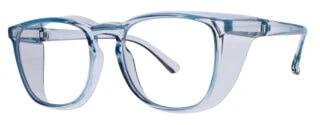



If you’ve ever worn safety frames, you’ve likely seen “Z87” stamped on the frame. When it comes to eye protection, that small plus sign in “Z87+” makes a big difference in how much protection the frames provide.
If you’re wondering which stamp you actually need — ANSI Z87+ vs. Z87.1 — allow us first to address the core confusion. ANSI Z87.1 is the name of the safety standard, while the plus (+) symbol indicates that the frames have passed the standard’s high-impact testing requirements.
The distinction is essential, depending on your line of work. Glasses marked with the basic “ANSI Z87” stamp don’t provide the same protection as those bearing the ANSI Z87+ high-impact rating. Wearing safety glasses rated for basic impacts only in a high-impact environment leaves you vulnerable to severe workplace eye injuries and noncompliance fines.
To help you prevent both, Rx-Safety carries a comprehensive line of custom prescription safety eyewear certified to meet exact ANSI standards for various applications. Before you browse, we’ll explain how to read safety glass markings and what they mean.
The first standard in the United States for eye and head protection dates back to 1922. In 1968, the American National Standards Institute (ANSI) published the standard that forms the foundation of the current version, Z87.1-1968.
Over the years, the standard has seen several revisions. Early in the 21st century, the International Safety Equipment Association (ISEA) became involved with the publication of ANSI/ISEA Z87.1-2003. Since 2003, ISEA and ANSI have maintained and updated the standard, with the latest revision published in 2025.
The current standard, ANSI/ISEA Z87.1-2025, establishes strict protocols for the design, construction, testing, and use of eye and face protection, including safety glasses, goggles, face shields, and welding helmets, to protect against hazards like impact, liquid splash, dust, and radiation.
Under ANSI Z87.1 safety standards, eye, face, and head protection must meet stringent performance requirements to receive certification.
Technicians assess a pair of glasses for structural integrity by subjecting them to several impact tests, resulting in a pass-or-fail determination. These tests assess the lenses and frames simultaneously.
A piece of eyewear fails the structural integrity component of an impact test if any of these outcomes occur:
By evaluating structural integrity during impact testing, technicians confirm that the frames and lenses function as a unified system. A strong lens is useless if the frame snaps upon impact, and a rugged frame is ineffective if it cannot retain the lens.
Safety glasses must pass multiple tests to receive ANSI Z87+ vs. Z87.1 certification. These tests determine whether a pair of safety glasses will remain intact through a series of punishing impacts.
We’ll break down the differences between basic impact (Z87) and high impact (Z87+) ratings.
Basic Impact (Z87.1 / Z87)
To achieve a basic impact rating, lenses must withstand a drop-ball test, in which a 1-inch steel ball weighing 68g falls from a height of 50 inches.
High Impact (Z87+)
High-impact testing is more rigorous and requires safety glasses to withstand:
Prescription Markings (Z87-2+)
If the frames accept prescription lenses, the stamp will indicate this. Z87-2 indicates prescription eyewear that provides basic impact protection, while Z87-2+ indicates prescription eyewear certified for high-impact protection.
Generally, you’ll find safety certifications stamped or etched on the inside of the temple arms near the earpieces, on the front of the frames, or at the top outer edge or corner of either lens. The manufacturer’s logo or trademark symbol usually appears first, followed by the rating code.
In addition to the Z87, Z87+, Z87-2, or Z87-2+ impact ratings, you may see other codes, each indicating another type of protection the safety glasses provide.
These codes indicate your safety glasses protect against:
Other codes you might see on safety glasses include:
If you’re deciding between ANSI Z87+ vs. Z87.1 safety glasses, consider your job tasks and working environment.
Choose basic impact protection (Z87) for light-duty tasks in low-risk environments, such as lab work, painting, light assembly, or woodworking with manual tools.
Safety glasses that provide high impact protection (Z87+) are best for construction, machining, welding, automotive repair, shooting sports, or any environment involving high-velocity flying particles.
When it comes to eye protection, you shouldn’t have to guess. Always verify your workplace requirements before buying, and match the safety ratings to your specific application.
Browse Rx-Safety’s catalog of ANSI Z87+ high-impact certified prescription safety glasses and customize your lenses today.
Stay on top of the latest news about prescription safety glasses, eyewear, sunglasses, and all the trends in the industry.
DISCOVER NOWBe the first one to know about promotion, new products, and more.
Follow Us On Instagram @rx_safety